 Grassie Trophy Logistics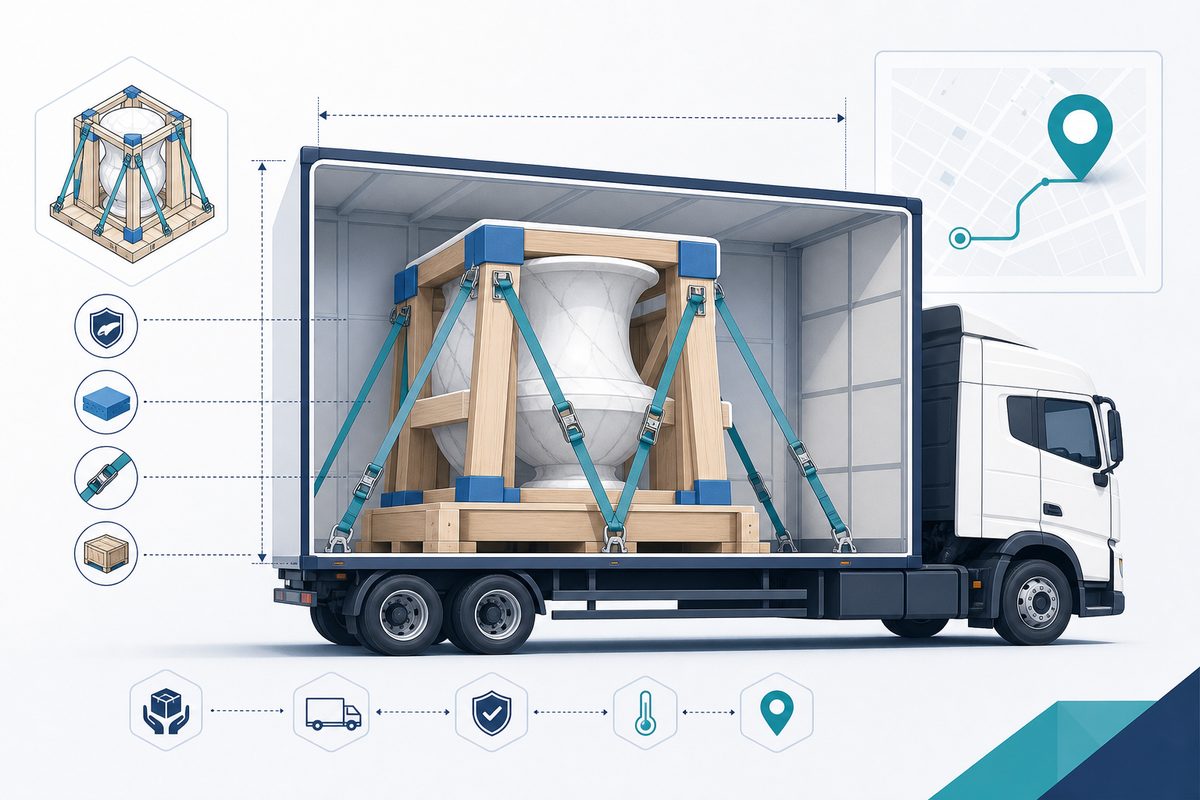
Start with honest measurements
The single most common cause of a failed oversized move is bad numbers at the start. A load that's "about eight feet wide" is either legal or illegal depending on which side of a hard line it falls, and "about" is not a number a permit office accepts. Before anything else, measure the load at its extremes: maximum length, maximum width, maximum height as it will sit on the trailer (deck height matters — a tall item on a standard deck can bust height limits that the same item clears on a lowboy), and actual weight, not estimated.
Why it matters: in most states a load wider than 8 feet 6 inches, taller than 13 feet 6 inches, or longer than roughly 48–53 feet crosses from "legal" into "oversize permit required." Weight has its own thresholds. Each threshold you cross adds permits, and some add escorts, route restrictions, and travel-time limits. Getting the measurements right on day one determines the entire plan and the entire cost.
Understand permits — they're a patchwork
There is no single national oversize permit. Each state issues its own, with its own limits, fees, and rules, and a cross-country move can mean a stack of them. Some states restrict oversize travel to daylight hours; some prohibit it on weekends or holidays; some require specific routes that avoid low bridges or weight-restricted roads; some mandate escort vehicles above certain dimensions.
A permit isn't paperwork you file after planning the route — the permit rules are the route.
This is why an oversized quote takes longer than a standard one, and why a carrier who quotes an oversize load in five minutes should worry you. The permit turnaround itself — sometimes same-day, sometimes several business days — also drives your earliest possible pickup. Build it into the timeline instead of discovering it the day you wanted to ship.
Escorts and pilot cars
Above certain dimensions, states require pilot cars (escort vehicles) ahead of, behind, or on both ends of the load. Very large loads may require a police escort. Pilot cars do real work: they warn traffic, scout for obstructions the driver can't see, and confirm clearance at bridges and tight turns before the truck commits. They are a cost and a scheduling factor, and they are not optional where required — moving an escort-required load without escorts risks fines, impoundment, and voided insurance.
Crating and securement: fragility is not just weight
A five-ton machine and a five-ton sculpture are the same weight and completely different shipping problems. Specialty freight is often defined by fragility, sensitivity, or irreplaceability rather than size. The securement plan has to match the item, not just the pounds:
- Custom crating for items that can't take direct strapping — a wooden crate distributes force and shields against impact and weather.
- Blocking and bracing so the item cannot shift, even under hard braking. Movement in transit is where damage is born.
- Soft materials — moving blankets, foam, edge protectors — anywhere a strap or the crate contacts a finished surface.
- Climate awareness for electronics, instruments, or anything sensitive to heat, cold, or humidity, which may call for an enclosed or climate-controlled trailer rather than a flatbed.
Insurance: confirm the number before you ship
Standard cargo insurance has limits, and a high-value specialty item can exceed them. Before booking, state the declared value of the item in writing and confirm the coverage actually meets it — don't assume. For irreplaceable or extremely high-value freight, additional coverage is often worth the small extra cost against the catastrophic downside. A reputable carrier will raise this proactively; if nobody mentions insured value on a valuable load, that's a red flag about the whole operation.
The planning timeline
Put it together and a specialty move runs backward from the delivery date, not forward from today. Roughly: confirm measurements and value → determine legal-vs-permit status → plan the compliant route → file permits and book escorts → build crating and securement → schedule pickup within permit and escort windows → move, with milestone updates → deliver, place, and confirm. The moving is the short part. The planning is the job, and it's exactly the part a rushed or bargain carrier skips — which is why the cheapest oversized quote is so often the most expensive move.
The takeaway
Oversized and specialty freight is not general freight scaled up; it's a planning discipline with a truck at the end of it. Measure honestly, respect the permit patchwork, match securement to fragility, confirm insurance to value, and work the timeline backward from delivery. Do that — or hire someone who does — and the "nightmare" reputation of oversized shipping simply evaporates.
Have a load like this? Get a quote or call (555) 274-4863.